Every farmer knows that a drip or sprinkler irrigation system is only as good as its filtration. The moment sand, algae, or chemical slit passes into your lines, you face clogged emitters, uneven watering, and costly crop damage.
But with so many options on the market, how do you choose the right agricultural irrigation filter? To choose the correct irrigation filter, you must match your water source (well, pond, or canal) to the specific contaminant type (sand, organics, or silt) and select the correct mesh size required by your downstream emission devices (drip lines vs. sprinklers).
This comprehensive guide will break down the exact steps, filter types, and technical specifications you need to make the right investment for your farm.
1. Quick Selection Chart: Match Your Water Source to the Right Filter
If you need a quick answer to get your system up and running, use this industry-standard matrix to align your primary water source with the proper primary and secondary filtration technologies:
| Water Source Type | Primary Contaminants | Recommended Primary Filter | Recommended Secondary Filter |
| Deep Well / Borewell | Heavy sand, fine grit | Hydrocyclone (Centrifugal Sand Separator) | Disc Filter or Screen Filter |
| Surface Water (Ponds, Lakes, Reservoirs) | Algae, organic slime, leaves, snails | Sand Media Filter or Automatic Disc Filter | Disc Filter |
| Rivers & Irrigation Canals | Silt, floating debris, fluctuating sand | Automatic Screen Filter or Sand Media | High-mesh Disc Filter |
| Municipal / Clean Well Water | Trace scale, rust particles | None (Direct Feed) | Manual Screen Filter |
2. Understand the Three Main Types of Irrigation Water Filters
Different filters are engineered to handle different types of debris. Choosing the wrong type means your filter will either clog every 10 minutes or let dangerous particles slip right through.
Screen Filters: Best for Inorganic Debris & Budget-Friendly Systems
Screen filters use a rigid mesh screen (made of stainless steel or nylon) to physically block particles.
- Best Used For: Well water containing sand, scale, or inorganic debris.
- Pros: Highly economical, simple to understand, and easy to clean manually.
- Cons: Poor performance against organic matter. Algae and slime can easily smash flat against the screen, blinding it rapidly and making it incredibly difficult to wash off.
Disc Filters: The Versatile Heavy-Hitter for Organic and Inorganic Matter
Disc filters feature a spine stacked tightly with grooved plastic rings. The water is forced through the microscopic tracks created by these grooves, providing three-dimensional, “depth” filtration.
- Best Used For: Open water sources (ponds, canals) with moderate organic loading, algae, and sand.
- Pros: Incredible efficiency at capturing both sticky biological matter (slime/moss) and sharp particulates. They are easier to flush clean from organic debris than screens.
- Cons: Slightly higher initial cost than basic screen filters.
Sand Media Filters: Essential for High-Volume, Dirty Surface Water
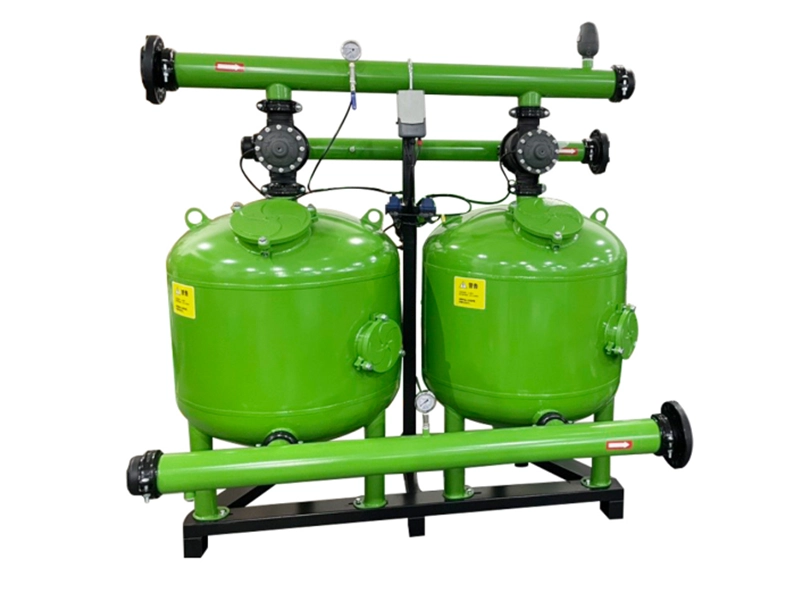
Sand media filters utilize a pressurized tank filled with graded silica sand. As water passes through the sand bed, contaminants get trapped in the tiny spaces between the grains.
- Best Used For: Large-scale commercial farms pumping from open rivers or ponds with heavy algae blooms.
- Pros: Unmatched dirt-holding capacity; excellent for deep biological filtration.
- Cons: Expensive upfront cost, large physical footprint, and requires a high-volume backwash system to clean the sand.
3. Choose Your Mesh and Micron Size Based on Your Crop Emitters
Once you know the type of filter, you must select the filtration grade. This is measured in Mesh (the number of holes per square inch) or Microns (the actual spacing size). A higher mesh number means a finer filtration level.
Gold Standard Rule: Your filter should trap any particle larger than 1/20th to 1/10th the diameter of your emitter’s smallest opening.
Refer to this breakdown to match your emission devices:
- Rotors and Large Sprinkler Spray Nozzles: Minimum 80 Mesh (200 Microns)
- Standard Drip Emitters, Micro-Sprayers, and Spray Jets: Minimum 120 Mesh (130 Microns)
- Thin-Walled Drip Tape (Common in row crops): Minimum 155 Mesh to 200 Mesh (100 to 74 Microns)
If your system blends multiple types of emitters, always filter to the strictest (highest mesh) requirement on the line.
4. Determine Your Operation Style: Manual vs. Automatic Backwashing
How much time do you have to spend cleaning filters?
- Manual Filters: Affordable but require a operator to physically shut down the system, pull out the element, and spray it down when the pressure differential drops. Best for small acreage or very clean water.
- Semi-Automatic Filters: Feature an internal brush or flush valve. You turn a handle while the system is running to clean the element without dismantling it.
- Automatic Self-Cleaning Filters: Monitor the pressure difference between the inlet and outlet. When the filter gets dirty, a motorized flush valve automatically opens, backwashing the system while continuing to irrigate your fields. Essential for large-scale B2B commercial operations where labor costs are high.
5. Summary Checklist for Smart Buyers
Before finalizing your purchase order, ensure your filter selections meet these core engineering metrics:
- Flow Rate (GPM or m³/h): Ensure the filter can handle your pump’s maximum flow rate without causing a massive pressure drop.
- Pressure Rating: Double-check that the filter body can withstand your system’s maximum operating pressure (typically rated in PSI or Bar).
- Future Expansion: If you plan to add more acres next season, size your filter housing up right now to prevent bottlenecking later.
Frequently Asked Questions (FAQ)
Q: What is the difference between mesh and micron?
A: Mesh counts the number of openings per linear inch of a screen. Micron measures the actual distance between those openings in millionths of a meter. Therefore, a larger Mesh number represents a smaller, finer Micron filtration level.
Q: Why is my irrigation filter clogging up so quickly?
A: If your filter clogs within hours, you likely have an organic algae issue paired with a screen filter, or your filter surface area is simply too small for your water’s dirt load. Consider upgrading to a depth-style disc filter or adding a primary sand separator.
Q: Can I run a drip system without a filter if I use clean well water?
A: No. Even clean well water carries deep underground silt, pipe scale, or chemical precipitates (like iron or calcium carbonate) that will eventually bake inside your drip lines and permanently ruin your emitters.