
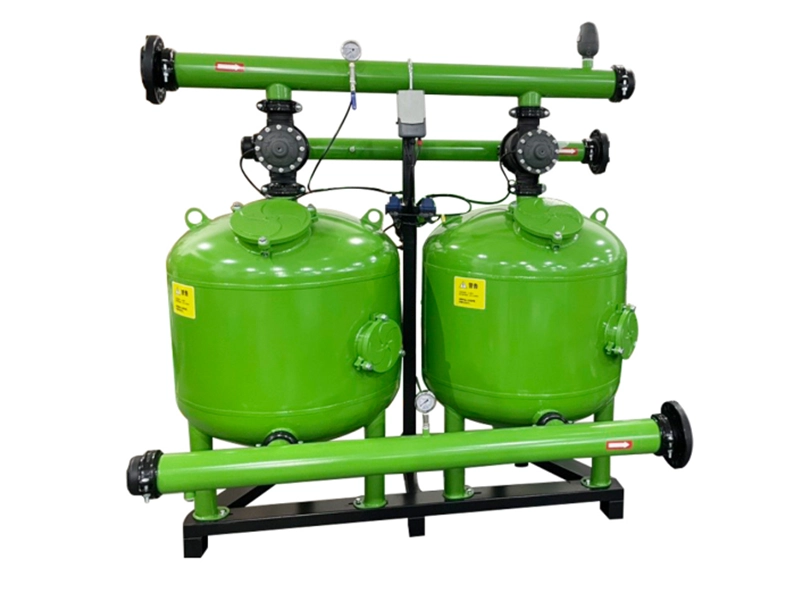
Product Overview
The sand filter is a filtration device commonly used in fields such as agricultural irrigation and water treatment. It mainly uses a filter bed composed of sands with different particle sizes to intercept and filter suspended particles, sediment, algae and other impurities in the water flow, thus purifying the water quality. In the agricultural irrigation system, it can effectively protect drip irrigation, micro – sprinkler irrigation and other equipment, preventing them from being blocked by impurities and affecting the irrigation effect. At the same time, it is also widely used in some small – scale sewage treatment, landscape water purification and other scenarios.
Product Features
- High – efficiency Filtration: Through a multi – level sand filter bed, it can efficiently intercept impurities of different particle sizes. The filtration effect is remarkable, and it can effectively remove most of the suspended matter in the water.
- Large Filtration Area: The internal structure is reasonably designed, so that the contact area between the water flow and the sand filter bed is large, thus improving the filtration efficiency.
- Long Service Life: As a filtration medium, sand has good abrasion resistance and corrosion resistance. The overall structure of the equipment is solid, ensuring a long service life.
- Convenient Back – flushing: It is equipped with a special back – flushing device. When impurities accumulate to a certain extent in the filter bed, back – flushing can be carried out through simple operations to restore the filtration performance.
- Applicable Materials and Scenarios:
It is applicable to various water sources containing suspended particles, sediment, algae and other impurities, such as river water, lake water, well water, etc. It is suitable for scenarios such as field irrigation, orchard irrigation, flower – planting irrigation in agricultural irrigation, as well as small – scale sewage treatment plants, landscape water purification, industrial circulating water filtration and other fields.
Parameter Table
| Parameter Name | Parameter Details |
| Filtration Precision | 10 – 100μm (customizable) |
| Working Pressure | 0.2 – 0.6MPa |
| Flow Range | 10 – 500m³/h |
| Tank Material | Carbon steel anti – corrosion/FRP (optional) |
| Sand Particle Size | 0.5 – 2mm (adjustable) |
| Back – flushing Time | 3 – 10min (adjustable) |
Company Strength Display
As an enterprise specializing in the manufacturing of intelligent agricultural water – fertilizer integration equipment, irriferti also has profound strength in the research, development and production of related filtration equipment such as sand filters. We have a professional technical R & D team that continuously optimizes product design and improves product performance. Advanced production equipment and a strict quality control system ensure that each sand filter can meet high – quality standards. Over the years, with high – quality products and perfect after – sales service, we have won the trust of a large number of customers. Our products are widely used in many agricultural irrigation and water treatment projects at home and abroad.
Frequently Asked Questions and Professional Answers from Customers:
Q: How to determine the filtration precision of the sand filter?
A: Determining the filtration precision needs to comprehensively consider the water quality of the water source and the requirements of subsequent water – using equipment. If the impurities in the water source are relatively large in particle size and the subsequent equipment is not very sensitive to blockage, a lower precision (such as 50 – 100μm) can be selected. If the impurities in the water source are fine and the subsequent equipment, such as drip irrigation heads, is extremely sensitive to blockage, a higher precision (10 – 30μm) is required. At the same time, factors such as actual operating costs also need to be considered to finally determine the appropriate filtration precision.
Q: How to determine the back – flushing frequency?
A: The back – flushing frequency depends on the water quality of the water source and the frequency of use of the filter. Generally speaking, in the case of poor water quality and high frequency of use, the back – flushing frequency is relatively high. You can observe the pressure difference between the inlet and outlet of the filter. When the pressure difference reaches a certain set value (such as 0.05 – 0.1MPa), back – flushing is required. You can also set a fixed time interval based on experience, such as back – flushing once a day or once a week. In actual operation, it can be adjusted flexibly according to the operating conditions.
Q: What is the impact of different tank materials on the performance of the sand filter?
A: Carbon steel anti – corrosion tanks are relatively low in price, have good strength and rigidity, and are suitable for general environmental conditions. However, when in long – term contact with water sources with strong corrosiveness, attention should be paid to anti – corrosion maintenance. FRP tanks have good corrosion resistance, are light in weight and convenient for installation, especially suitable for scenarios where the water quality has certain corrosiveness or there are requirements for the weight of the equipment. However, their strength is relatively slightly weaker than that of carbon steel, and external impact should be avoided during installation and use.